
The short answer
Diamond clarity describes inclusions and blemishes. Because grading is done under 10x magnification, the showroom question is often simpler: does the diamond look eye-clean in normal viewing? If yes, you have room to focus on cut, carat, color, or setting.
Do not pay for clarity your eye cannot see.

Eye-clean beats impressive paperwork for most rings
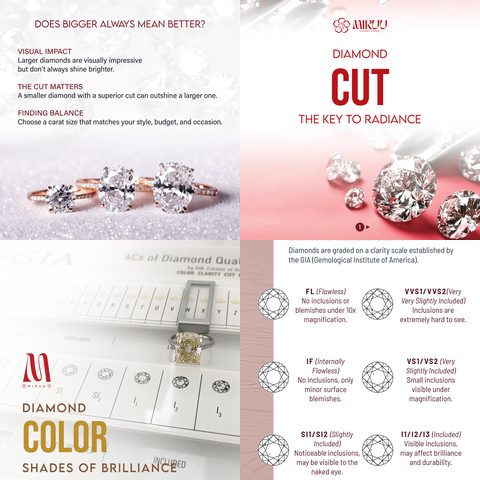
Clarity grading considers internal inclusions and external blemishes. The common GIA clarity categories move from Flawless and Internally Flawless through VVS, VS, SI, and Included grades. Those labels are useful, but beginners should remember how the grades are assessed: under magnification, not from casual viewing distance.
| Grade group | Plain-language idea | What to notice |
|---|---|---|
| FL / IF | No inclusions visible under 10x, or only minor surface features for IF. | May not create visible difference in everyday viewing. |
| VVS / VS | Very small inclusions that are difficult or usually hard to see without magnification. | Often worth comparing if the stone looks clean to the eye. |
| SI | Slight inclusions that may or may not be visible depending on the stone. | Needs careful viewing and location review. |
| I | Included, with inclusions that can be visible or affect durability. | Needs extra caution before choosing. |

Buy clarity only until distraction disappears
Eye-clean means inclusions are not obvious to the unaided eye in normal viewing. It does not mean the diamond has no inclusions. It means the clarity characteristics do not distract from the ring when the stone is worn and admired naturally.
This language helps buyers avoid paying for invisible differences. If two stones both look clean to the eye, improving cut or choosing a more suitable setting may make a bigger visible difference than moving higher on clarity.
Location matters more than the grade alone
Two diamonds with the same clarity grade can look different. An inclusion near the edge may be less noticeable or easier to hide with a prong. An inclusion under the table can be easier to see. Type, size, contrast, and position all matter.
Ask where the inclusion is, not only what the grade says. Then check whether it is visible in normal viewing.
A hidden inclusion is not the same problem as an inclusion under the table.
Where clarity deserves more attention
Give clarity enough attention to avoid visible distractions or durability concerns. After that, ask whether cut, carat, color, or the ring design would create a more noticeable improvement. Choose clarity for what the eye will actually see; on paper it is a ladder, but in person it is often an eye-clean question.
Trying to read a clarity plot?
Include the stone shape and grading details. Ask where the inclusions sit and whether they are visible in normal viewing.
Check whether it is eye-cleanWhere buyers get clarity wrong
- Paying for a difference no one can see. A higher clarity grade may not change how the ring appears on the hand.
- Ignoring inclusion location. Where the inclusion sits can matter as much as the grade group.
- Assuming all inclusions affect sparkle. Some are too small or positioned too far from the main view to matter visually.
- Reading clarity apart from the other Cs. Cut, carat, color, and setting still shape the final choice.
If you remember three things
- Clarity describes inclusions and blemishes.
- Clarity grading uses 10x magnification.
- Eye-clean is often the more useful buyer question.
- Inclusion location, type, and visibility matter.
- Clarity should be balanced against cut, carat, color, and design.
What to ask any jeweler, including Miruu
- Is this diamond eye-clean in normal viewing?
- Where are the inclusions located?
- Would improving cut or color matter more than improving clarity?
- Can you show the clarity plot or grading details for this stone?
FAQ
What does diamond clarity mean?
Clarity describes internal inclusions and external blemishes in a diamond.
What does eye-clean mean?
Eye-clean means inclusions are not obvious to the unaided eye in normal viewing, even if they exist under magnification.
Do all inclusions affect sparkle?
No. Some inclusions are small, off to the side, or only visible under magnification. Location and type matter.
Do I need a flawless diamond?
Not for many engagement rings. A diamond can look clean to the eye without being flawless under magnification.
References
For clarity terminology, start with GIA clarity education and GIA 4Cs education. Clarity grades matter most when the inclusion is visible, distracting, or relevant to the stone you are considering.
Related guides


Want help reading clarity grades?
Include your ring peg, stone shape, and budget range. Ask how clarity, cut, and color work together for the setting you are considering.
Read clarity for your ring